
Professional Solar Panel Cleaning Services: Benefits, Costs & When You Need Them
By Team Faseeh Lall
Solar panels spend their entire working life outdoors. Dust, pollen, bird droppings, leaves, pollution, construction debris, and other contaminants can gradually collect on the module surface.
While rainfall can remove some loose dirt, it does not always keep a solar array completely clean. The U.S. Department of Energy identifies regular maintenance and cleaning as part of effective photovoltaic system operations and maintenance, while NREL notes that soiling can reduce solar energy output.
That is why professional solar panel cleaning services can become an important part of maintaining residential, commercial, and larger solar installations.
Professional cleaning is not simply about making panels look better. The goal is to safely remove accumulated contamination while protecting the glass, coatings, wiring, mounting equipment, and surrounding property.
Why Do Solar Panels Need Cleaning?
Solar panels generate electricity when sunlight reaches photovoltaic cells.
Anything that blocks part of that sunlight can potentially interfere with energy production.
Common types of solar panel soiling include:
Dust and dirt
Pollen
Bird droppings
Leaves and organic debris
Diesel soot
Construction dust
Agricultural dust
Industrial pollution
Ash
Salt deposits in coastal environments
NREL identifies agricultural and construction dust, pollen, bird activity, diesel soot, and industrial sources as common causes of PV module soiling.
The amount of buildup varies significantly by location.
A solar system next to a construction site may become dirty much faster than panels installed in an area with frequent rainfall and little airborne pollution.
For this reason, there is no single cleaning schedule that works perfectly for every solar installation.
What Are Professional Solar Panel Cleaning Services?
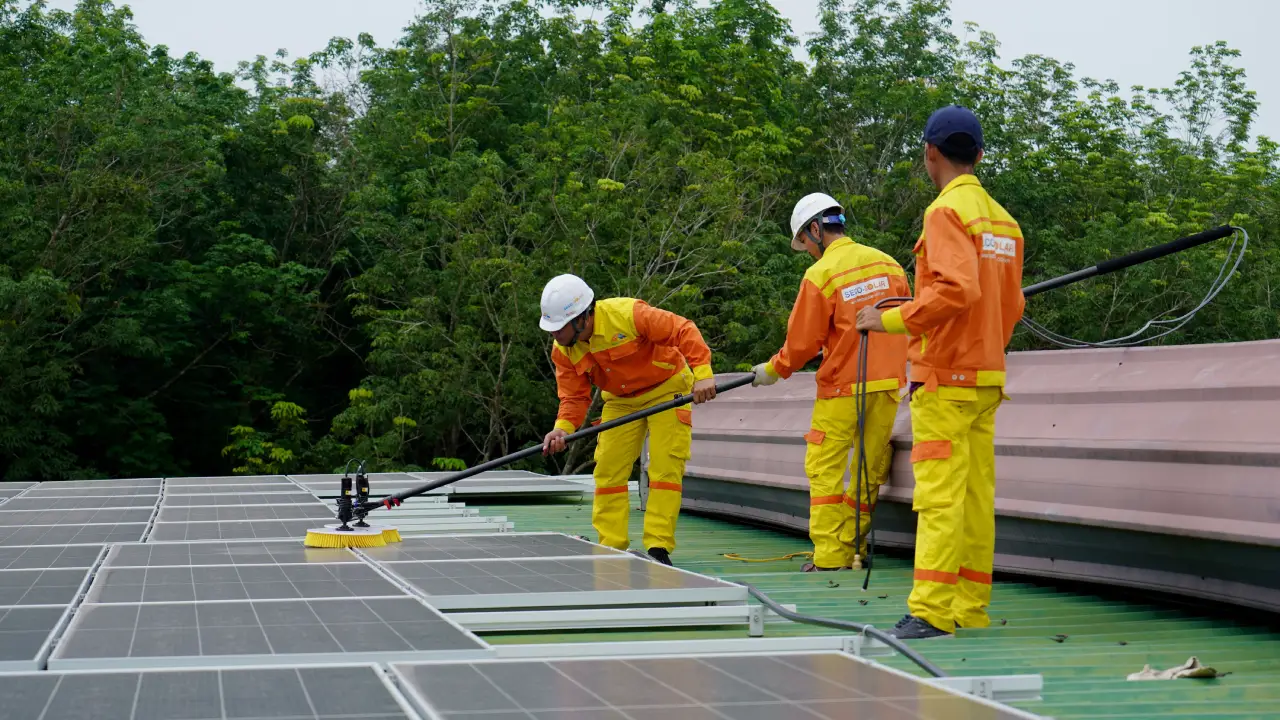
Professional solar panel cleaning services involve removing dirt and contaminants from photovoltaic modules using methods and equipment suitable for solar systems.
Depending on the provider and system, professional service may include:
Visual inspection of the array
Removal of loose debris
Cleaning of module surfaces
Removal of bird droppings and stubborn deposits
Inspection for obvious physical damage
Before-and-after condition checks
Basic performance observations
Scheduled ongoing cleaning
Commercial providers may also offer cleaning as part of a broader solar operations and maintenance program.
The U.S. Department of Energy recommends incorporating preventive maintenance, inspection, testing, and cleaning into a PV operations and maintenance plan.
Can Dirty Solar Panels Produce Less Energy?
Yes. Accumulated soiling can reduce the amount of sunlight reaching photovoltaic cells.
The size of the loss depends heavily on environmental conditions, panel angle, rainfall, type of contamination, and how long debris remains on the modules.
NREL materials note that PV soiling can result in annual energy losses exceeding 6% in some circumstances, although actual losses are highly site-specific.
This does not mean every dirty solar array will automatically lose the same percentage of production.
A lightly dusty array in a rainy climate may experience relatively little impact, while systems exposed to heavy dust, pollution, bird activity, or dry weather may require more frequent attention.
Why Hire Professionals Instead of Cleaning Panels Yourself?
Cleaning a ground-level panel may appear straightforward.
Rooftop solar systems are different.
Homeowners may need to deal with:
Working at height
Wet roof surfaces
Electrical equipment
Difficult panel access
Fragile module surfaces
Manufacturer cleaning requirements
Using the wrong tools or cleaning products can also create problems.
The Department of Energy advises against inappropriate cleaning equipment and notes that high-pressure hoses can potentially damage module glass. It also warns that cleaning tools not designed for PV modules can increase the risk of damage.
A professional solar cleaning company should understand how to clean the system without using unnecessary pressure, harsh abrasives, or unsuitable chemicals.
Benefits of Professional Solar Panel Cleaning
Help Maintain Solar Performance
Removing accumulated contaminants helps ensure that sunlight has clear access to the module surface.
Cleaning is particularly relevant when visible dirt, bird droppings, pollen, ash, or other material is covering part of the array.
Regular PV operations and maintenance can support energy delivery and reduce system downtime over the operating life of a solar installation.
Safer Rooftop Maintenance
Getting onto a roof introduces fall and access risks.
Professional cleaners typically have appropriate equipment and experience for working around rooftop solar arrays.
For property owners, avoiding unnecessary roof access may be one of the biggest reasons to hire a professional service.
Reduce the Risk of Improper Cleaning
Solar modules are durable, but that does not mean every cleaning method is appropriate.
Hard brushes, abrasive materials, unsuitable chemicals, and excessive pressure may damage module surfaces or coatings.
NREL guidance generally points toward appropriate water-based cleaning and avoiding abrasive methods, while also emphasizing that manufacturers may provide specific cleaning instructions.
Identify Visible Problems Early
A professional cleaner may notice obvious issues while working around the array, such as:
Cracked modules
Loose debris
Heavy bird nesting
Damaged wiring
Corrosion
Loose components
Unusual staining
Cleaning should not be treated as a replacement for electrical inspection or professional solar maintenance, but regular visual observation can help surface issues that deserve further investigation.
How Often Should Solar Panels Be Professionally Cleaned?
There is no universal rule such as "every three months" or "twice per year" that applies to every solar installation.
Cleaning frequency should be based on site conditions.
Factors include:
Local Weather
Regular rainfall can naturally remove some dust.
Areas with long dry periods may experience more persistent buildup.
Dust Levels
Properties near construction projects, unpaved roads, agricultural land, industrial areas, or desert environments may require more frequent cleaning.
Bird Activity
Bird droppings can produce concentrated areas of contamination that rainfall may not easily remove.
Panel Tilt
Steeper panels may shed certain contaminants more easily than nearly flat installations.
Trees and Vegetation
Nearby trees can contribute pollen, leaves, sap, and bird activity.
System Performance
A noticeable production decline that cannot be explained by weather or seasonal changes may justify inspecting the system for soiling or another maintenance issue.
The Department of Energy recommends adjusting cleaning schedules according to local sources of dirt and seasonal conditions rather than assuming one schedule works everywhere.
Does Rain Clean Solar Panels?
Rain can help.
It can remove some loose dust and light contamination, especially from tilted panels.
However, rainfall may not fully remove sticky pollen, bird droppings, heavy dirt, oily pollution, or deposits that have accumulated over time.
Think of a car windshield.
Rainwater can wash away loose dust, but it does not necessarily leave the glass completely clean.
Solar panels can face a similar situation.
Whether professional cleaning is necessary therefore depends on the level and type of contamination rather than simply whether the area receives rainfall.
What Happens During Professional Solar Panel Cleaning?
The exact process varies by provider, but a professional service typically begins by assessing the system.
Initial Inspection
Technicians inspect the panel condition, accessibility, type of buildup, roof or ground-mount environment, and any obvious risks.
Debris Removal
Leaves and loose debris may be carefully removed from and around the array.
Panel Cleaning
Panels are cleaned using an appropriate method based on the system and manufacturer recommendations.
The objective is to remove contamination without scratching or damaging the surface.
Final Check
The technician may visually review the modules after cleaning and document any obvious issues discovered during service.
Some solar maintenance companies also provide photographs or service reports.
Residential Solar Panel Cleaning
Residential systems usually involve relatively small arrays, but roof access can make cleaning difficult.
Professional residential solar panel cleaning may be useful when:
Panels have visible dirt
Birds frequently sit near the array
Trees create heavy pollen or debris
The property is near construction
The area has long dry seasons
Output appears lower than expected
Roof access is unsafe for the homeowner
A professional service can clean the array without requiring the homeowner to climb onto the roof.
Commercial Solar Panel Cleaning
Commercial systems create different challenges.
Large rooftop and ground-mounted arrays may contain hundreds or thousands of panels.
Even small efficiency losses across a large installation can become operationally significant.
Commercial cleaning programs may therefore be based on:
System performance
Soiling measurements
Site conditions
Electricity value
Cleaning costs
Seasonal weather
For large installations, the most economical solution is not necessarily cleaning as often as possible.
DOE materials emphasize balancing cleaning costs against production losses caused by dirt.
How Much Do Professional Solar Panel Cleaning Services Cost?
Solar panel cleaning prices vary significantly.
Factors affecting cost may include:
Number of panels
Roof height
Roof pitch
Accessibility
System configuration
Ground-mounted vs. rooftop system
Amount of dirt
Type of contamination
Property location
Water access
Commercial vs. residential system
Additional inspection requirements
Because these factors vary, homeowners and businesses should request a quote based on the actual solar system rather than relying on a generic national price.
A very low cleaning quote should also be evaluated carefully.
The lowest price may not represent the best value if the provider lacks appropriate equipment, insurance, solar experience, or safe working practices.
How to Choose a Solar Panel Cleaning Company
Before hiring a company, ask what experience it has working specifically with photovoltaic systems.
You should also understand:
What cleaning method will be used?
What equipment will be used?
Are harsh chemicals or abrasives avoided?
Does the company carry appropriate insurance?
Does it have experience with rooftop solar?
Will technicians follow manufacturer recommendations?
Are inspection photos provided?
What is included in the quoted price?
Is there a recurring service contract?
What happens if damage occurs during service?
Professionalism matters because solar panels are long-term energy assets, not ordinary windows.
Solar Panel Cleaning vs. Solar Maintenance
Cleaning and maintenance are related, but they are not the same service.
Solar panel cleaning focuses primarily on removing contamination from the module surface.
Solar maintenance may include broader system checks involving:
Electrical components
Wiring
Connectors
Inverters
Mounting systems
Corrosion
Monitoring equipment
System performance
Physical module condition
DOE guidance treats cleaning as one part of a broader preventive operations and maintenance strategy.
If a solar system is producing substantially less electricity than expected, cleaning should therefore not automatically be assumed to be the only solution.
The system may require diagnostic testing.
Are Professional Solar Panel Cleaning Services Worth It?
The answer depends on the solar system and local conditions.
Professional cleaning can make sense when panels have substantial visible buildup, difficult roof access, recurring bird contamination, heavy dust exposure, or measurable soiling-related production losses.
In other cases, natural rainfall may keep panels sufficiently clean for long periods.
The best approach is to base cleaning decisions on actual conditions rather than an arbitrary schedule.
For commercial systems, performance data and soiling monitoring can help determine whether the expected energy recovery justifies the cleaning cost.
Final Thoughts
Solar panels are designed to operate outdoors for decades, but that does not mean they never require attention.
Dust, pollen, bird droppings, pollution, ash, and other contaminants can build up on modules and interfere with solar production.
Professional solar panel cleaning services provide a safer and more controlled way to remove this buildup while reducing the risk of improper cleaning techniques.
The right cleaning schedule depends on the system, climate, surrounding environment, panel configuration, and actual level of soiling.
Rather than cleaning too often or waiting until panels are heavily contaminated, solar owners should combine visual inspections, performance monitoring, manufacturer guidance, and site-specific conditions to determine when professional cleaning makes sense.